

Nonprofit Executive Coaching: The Complete Guide
Our coaches see the same pattern across hundreds of applications. A nonprofit executive director describes their situation in a sentence or two: a board in conflict, a fundraising plateau, a staff team that keeps losing people. The specifics differ. The underlying condition is identical. They are making the most consequential decisions of their professional lives with no structured space to think them through. Their board has opinions. Their staff has needs. Their funders have expectations. Nobody in that ecosystem asks the question that would surface the assumption the ED did not realize they were operating under.
That gap is what nonprofit executive coaching addresses. Not the board conflict itself, not the fundraising numbers. The leader doing the work.
This guide explains what nonprofit executive coaching is, how it works at CNPC, what it costs, who it serves, and how to know whether your organization is ready. If you arrived wondering whether coaching is a corporate tool that has nothing to do with nonprofits, start at Section 1. If you already know coaching is relevant and want the process and pricing, start at Section 3.
Key Takeaways
- Nonprofit executive coaching helps leaders think more clearly about their most persistent challenges. It is not consulting, mentoring, or training.
- CNPC provides six-session coaching engagements starting at $300 for small organizations, because our coaches donate their time.
- The coaching process follows four phases: Preparation and Application, Matching, Targeted Coaching, and Holistic Monitoring.
- Coaching is not the right intervention for every situation. Organizations in existential crisis or with collapsed board-ED relationships need different support first.
- The application takes five minutes. CNPC reviews every submission and responds within two weeks.
What Nonprofit Executive Coaching Actually Is (and Is Not)
The International Coaching Federation defines coaching as a partnership between a coach and a client that supports the client in maximizing their personal and professional potential. That definition is accurate but abstract. In practice, for a nonprofit leader, it works like this.
A coach does not deliver a report. A consultant delivers a report. A consultant diagnoses your organization's challenge, applies their expertise, and hands you a set of recommendations. That is a valuable intervention for the right problem. When you need an external perspective on your financial model, your program evaluation framework, or your capital campaign strategy, a consultant is the right call. When the bottleneck is the leader's own capacity for decision-making, clarity, and accountability, a coach is the right call.
Mentoring draws on the mentor's experience. When a veteran ED sits down with a first-time ED and says "here's what I learned in year three," they are transferring knowledge from their own journey. That is genuinely useful. But mentoring is limited by the mentor's particular path. A coach draws on the leader's own thinking, not the coach's. This distinction matters for nonprofit leaders specifically because the sector rewards people who can figure things out in novel situations. Your organization's challenges are not the same as the veteran ED's challenges were fifteen years ago. A coach helps you develop your own analysis.
Coaching is also distinct from therapy. Therapy addresses the past. Coaching is forward-looking and goal-oriented. Sessions focus on specific challenges, decisions, or behavioral patterns the leader wants to shift. What coaching builds is the leader's own capacity. A consultant solves the problem for you. A mentor shares how they solved a similar problem. A coach helps you become the leader who can see the problem clearly enough to solve it yourself. For nonprofit leaders facing new versions of similar challenges throughout their tenure, that capacity compounds in a way borrowed expertise does not.
CNPC coaches only. Not consults. Not mentors. Not trains. That focus is deliberate, and it shapes everything about how the engagement works.
The leader who reads all the books on delegation and still cannot delegate does not have an information problem. They have a pattern problem. That is what coaching addresses.
Who Executive Coaching Serves in the Nonprofit Sector
Nonprofit executive coaching serves a varied population. The coaching needs of a first-time ED six months into their role differ substantially from the needs of a 15-year founder whose organization has outgrown its original structure. For resources for nonprofit executive directors at any career stage, the specifics matter. The populations our coaches work with most follow distinct patterns.
First-Time EDs in Their First 18 Months
The most common application pattern at CNPC is the new leader who applies about six months too late. By the time they reach out, the board relationship is already strained. They have been operating under assumptions they never examined, absorbing responsibilities that were not theirs to absorb, and managing their uncertainty privately because showing uncertainty felt unsafe.
First-time EDs typically apply with language like "I'm questioning choices and next steps in ways I wouldn't normally" or "I'm finding it hard to trust myself as a leader." The stated problem is often a specific external challenge: board dynamics, fundraising confidence, staff performance. The underlying pattern is almost always the same: they are doing the work without a structured space to examine their own role in it.
Transition coaching for new EDs focuses on building the internal framework for leadership before external pressures harden into habits: which decisions belong to the ED, which ones the board needs to own, and how to build the communication cadence that stops late-night calls from the board chair.
Veteran EDs Facing a New Challenge
Experience does not make every new challenge easier. A veteran ED who has run a $3M community development organization for a decade may have never managed a capital campaign, navigated a union bargaining process, or worked through a fiscal sponsor transition. These situations require thinking that their existing network cannot provide.
Organizations over $500K in operating budget often have senior staff who can carry operational load. The ED can focus on strategy and board relations. Coaching for these leaders tends to focus on decision-making clarity and accountability at that level.
Founders Navigating the Shift to Organizational Leader
Consider a grassroots organization with a $200K operating budget where the founder has been ED for 15 years. The board consists of friends from the early days. The organization has outgrown the founder's management style but not the founder's vision. That is a coaching conversation, not a consulting one. A consultant can restructure the org chart. Only the founder can examine the difference between the organization they built and the organization it has become.
Nonprofits with operating budgets under $500K face a structural constraint: the ED is often the entire senior leadership team. There is no COO to delegate to, no development director to own fundraising strategy. Coaching for founders in this position typically focuses on building the discernment to know what only the founder can do, and letting other things go.
Deputy Directors Being Groomed for the ED Role
Succession planning in the nonprofit sector is underdeveloped relative to the stakes. A deputy director who is the obvious next ED candidate often receives no structured preparation for the leadership shift. Coaching provides that preparation before the transition, rather than as remediation after it. The Bridgespan Group research on nonprofit leadership documents persistent capacity gaps across the sector. Investing in deputy directors through coaching builds both current organizational resilience and succession depth simultaneously.
How Nonprofit Executive Coaching Works at CNPC
CNPC's coaching process follows what we call the PATH model: four phases that take a nonprofit leader from application through a completed engagement with outcome tracking at the end. Our executive coaching program serves 501(c)(3) nonprofits, government agencies, and analogous non-U.S. entities. The four phases:
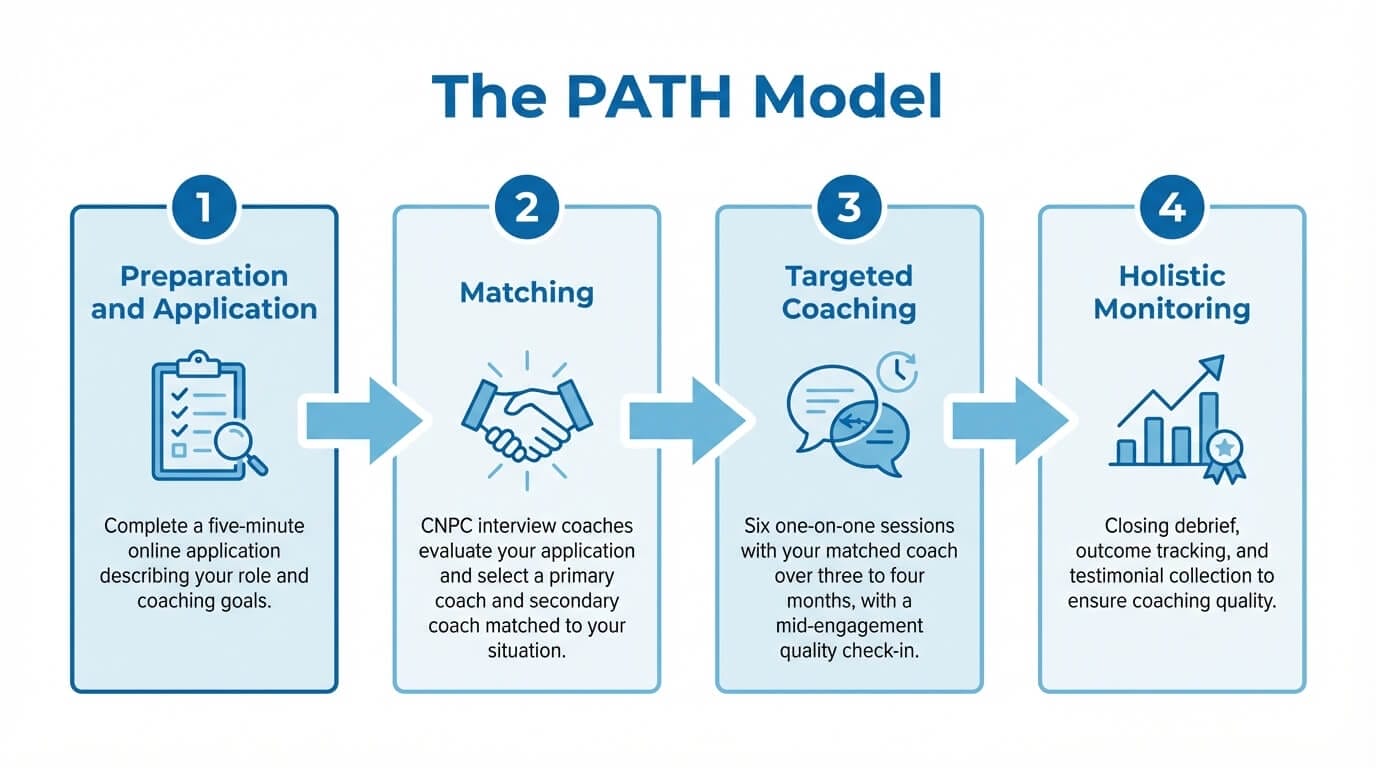
Preparation and Application. The application is an online form that takes about five minutes. It asks for the leader's role, organizational context, and what they hope to work on. Responses from real applications range from tight and specific ("improving strategic focus and time allocation") to open and exploratory ("I've never run a nonprofit before and I'm learning as I go"). Both are welcome. The application is a starting point for conversation, not a qualifying test.
CNPC reviews every application within two weeks. Unlike coaching platforms that route you to an available coach automatically, CNPC conducts an intake interview first. Interview coaches, who are separate from the coaches who will be assigned, evaluate the application and select a primary coach and a secondary coach for each client.
Matching. The matching step is where CNPC's process diverges most sharply from generic coaching platforms. Assignment is not random. It is based on organizational context (size, sector focus, current challenge type), coaching goals, and coach background. A first-time ED navigating union bargaining gets matched differently from a founder managing a fiscal sponsor transition. The goal is not a coach who is generally excellent. It is a coach whose specific experience is relevant to the client's specific situation. You can learn more about how the coaching process works.
“Coaching for CNPC lets me give back to the nonprofit sector, and I’m constantly inspired by the incredible individuals I meet as a coach. It’s a rewarding way to make an impact.”
CNPC volunteer coach
Targeted Coaching. Six sessions, typically delivered over three to four months. Virtual delivery, which means geography is not a constraint. A nonprofit leader in rural Montana or a small Pacific Islander community organization reaches the same coach pool as an organization in New York. A mid-engagement check-in (not from the assigned coach, but from CNPC) monitors quality during the engagement rather than waiting until the end. This monitoring step is something most coaching providers skip entirely.
Holistic Monitoring. After the six sessions close, CNPC collects a closing debrief. Outcomes are tracked. If the client is willing, testimonials are gathered. This is not simply an end-of-program survey. It feeds into how CNPC thinks about matching quality and coach development over time.
Our current coaching roster includes 49 coaches, 81% of whom hold ICF credentials: 3 Master Certified Coaches, 15 Professional Certified Coaches, and 20 Associate Certified Coaches. Volunteer does not mean unqualified. Our coaches are credentialed professionals who donate their time because they believe in the work that nonprofit leaders do.
The coaches we have spoken with cite three motivations: access to a client population they do not otherwise reach, the personal growth that comes from coaching leaders in mission-driven work, and the CNPC community itself, which provides support for coaches, not just clients. Acceptance is selective. Coaches go through a rigorous application and interview process. This is not an open-door volunteer program.
What Executive Coaching Costs for Nonprofits
At market rate, executive coaching costs $300 to $800 per hour. A standard engagement of 12 sessions runs $10,000 to $30,000, and that is before accounting for the premium firms and credentialing levels that push individual coaching well above those ranges. For most nonprofits, that number ends the conversation before it starts.
CNPC's pricing structure is different, and the difference is structural, not promotional. Our coaches donate their time because they want to support nonprofit leaders and mission-driven work. The pricing reflects the model:
| Organization Size (Annual OpEx) | Individual Coaching (6 sessions) | Team Coaching (6 sessions) |
|---|---|---|
| Small (under $250K) | $300 | $500 |
| Medium ($250K–$500K) | $400 | $700 |
| Large (over $500K) | $600 | $1,100 |
For a small nonprofit with a $200K annual operating budget, the six-session individual engagement costs $300. That is less than most nonprofits spend on a single conference registration. The ICF-credentialed coach delivering those sessions is the same quality as a coach charging $500/hour elsewhere. The economics work because the coach's time is donated, not discounted. No comparable access to credentialed coaching exists at this price point in the broader market.
If you want to understand what executive coaching costs for nonprofits across different funding approaches, including how to make the case to a funder or board for coaching as a professional development investment.
The tiered pricing by operating budget matters for a practical reason: organizations should not pay more than their size warrants. A $5M regional nonprofit and a $150K grassroots organization are not the same client. The tier system recognizes that. Team coaching for leadership groups is available at the same tiered structure for leadership teams that want to develop together.
The volunteer model is what makes all three tiers viable for organizations that would otherwise price themselves out of professional coaching entirely. Many nonprofits in the medium tier, those running $250K to $500K in annual operating budget, have never engaged a professional coach because the market rate was simply not in range. At $400 for six sessions with a credentialed coach, the calculus changes. That same structural difference applies to team coaching: a $700 engagement for a leadership team is an investment most nonprofit boards can approve with a single line item in the professional development budget. The pricing tiers are also designed to avoid a common nonprofit dynamic where smaller organizations subsidize services priced for large ones. A $300K organization and a $3M organization both receive credentialed, matched coaching. The fee reflects what each organization can reasonably invest, not a reduced or downgraded version of the service.
If your organization does not have a professional development line item in the budget, the first coaching conversation can help you build the case for why it should. Many of our coaches have direct experience helping nonprofit leaders make the case for capacity building investments to their boards and funders.
One of our coaches put it directly: “The Center for Nonprofit Coaching is leadership that genuinely cares about clients’ needs, supports my growth as a coach, and offers opportunity to impact executives I wouldn’t typically reach.” The volunteer model is a structural innovation, not an act of charity toward clients. How CNPC keeps coaching affordable is explained in full in the volunteer model article.
The question most nonprofit leaders ask is whether they can afford coaching. The more useful question is what it costs to keep making high-stakes decisions without a structured space to think them through.
What Coaching Can Realistically Accomplish in Six Sessions
Six sessions is not a personality overhaul. The most important thing CNPC can do for prospective clients is be honest about what that means. Articles that promise transformation without specifying the mechanism are selling something other than coaching. What a well-structured engagement can accomplish is specific, bounded, and worth knowing before you apply.
What six well-structured sessions with a matched coach can accomplish is specific and bounded. Clearer thinking about a board conflict that has been running in loops. A 90-day plan that distinguishes between what is urgent and what only feels urgent. Better delegation patterns that stop the ED from absorbing work that belongs to others. A communication cadence with the board chair that reduces 10 PM calls about things the ED could have anticipated.
The ICF Global Coaching Study consistently documents high rates of satisfaction and reported improvement across coached leaders. The data comes largely from corporate contexts, but the underlying mechanism, improved self-awareness and more deliberate decision-making, transfers directly to nonprofit leadership. For the full research summary, see the evidence-based benefits of executive coaching for nonprofit leaders.
One of the most consistent observations from CNPC's coaching practice: the problem a leader applies to solve is often not the actual problem. Consider a leader 18 months into the role at a mid-size human services organization ($1.2M operating budget). The board expects a capital campaign. The development director just resigned. The leader applies for coaching about "managing up and strategic planning." In session three, the coach asks which responsibilities on their current list actually belong to the ED role and which ones did they absorb because no one else was available. The capital campaign and the vacancy are real problems. The absorption pattern is the problem underneath them.
By session six, the leader has not run the capital campaign. They have developed a framework for the question they were not asking. That framework applies to the campaign, to the next vacancy, to the next board expectation that arrives without a mandate. Six sessions did not fix the broken board or replace the development director. It helped a leader see their own role in the pattern more clearly. The challenges remain to be addressed, with greater clarity.
Coaching vs. Other Professional Development Options
Coaching is one intervention among several. Each addresses a different kind of problem. Choosing the wrong one is not a failure of the leader. It is a mismatch between the intervention and what the situation requires. Consulting, mentoring, training, and peer learning all have distinct roles. The right answer depends on what gap actually needs closing.
For a detailed comparison of coaching vs. mentoring in the nonprofit context, see the full comparison. A summary of where each approach fits:
| Approach | What It Does | Best For | Typical Cost |
|---|---|---|---|
| Executive coaching | Builds the leader’s own capacity to think through challenges. One-on-one, goal-oriented, forward-looking. | Leaders who know what the challenge is but are stuck on how to approach it. Persistent patterns that knowledge alone hasn’t solved. | $300–$1,100 at CNPC; $10,000–$30,000 at market rate |
| Consulting | External expert diagnoses the problem and provides recommendations. The consultant does the analysis work. | Specific knowledge gaps: financial restructuring, program evaluation, capital campaign planning, HR policy. | $150–$350/hour; $5,000–$50,000 per engagement |
| Mentoring | A more experienced leader shares their experience and perspective. Knowledge and network transfer from mentor to mentee. | Career navigation, sector orientation, building professional network. Most effective for leaders early in their tenure who need context, not just skill. | Often free or low-cost; formal programs vary widely |
| Training | Skill instruction in a defined area. Structured curriculum, typically group-based. | Specific skill deficits: financial management fundamentals, fundraising basics, board governance practices, HR compliance. | $200–$2,000 per course; cohort programs $500–$5,000 |
| Peer learning groups | Cohort of nonprofit leaders sharing challenges and approaches. Horizontal knowledge sharing. | Leaders who want community and cross-sector perspective. Effective supplement to other interventions; rarely sufficient as a standalone development strategy. | $500–$3,000/year for facilitated programs; free for informal networks |
Most nonprofit leaders need more than one type of support over the course of their tenure. A first-time ED might benefit from mentoring in year one, training on financial management in year two, and nonprofit leadership coaching in year three when the presenting challenges are no longer knowledge gaps but leadership patterns. For a comprehensive comparison of nonprofit leadership development options, including certificate programs, peer learning, and coaching, see the full guide. The right question is not which approach is best in the abstract, but which gap needs to be addressed right now.
CNPC coaches exclusively. We do not consult, mentor, train, or run peer groups. If a client's situation calls for a different intervention, we say so. That scope clarity is not a limitation. Our coaches develop deep skill in one craft.
How to Know If Your Organization Is Ready for Coaching
Coaching is not the right intervention for every situation. Organizations that pursue it at the wrong time get less from it and sometimes develop skepticism that is actually warranted about the timing, not the approach itself. Four readiness signals suggest coaching will be productive. Three non-readiness signals point toward a different intervention first.
Readiness Signals
Coaching tends to be most effective when at least one of these conditions is present:
- A transition moment. New ED role, new board chair, new strategic plan cycle, major organizational restructuring. Transitions create the conditions for new patterns to form. Coaching during a transition helps those patterns form deliberately rather than reactively.
- A persistent challenge that knowledge alone has not solved. If you have read the books, attended the trainings, consulted with peers, and the same challenge keeps reappearing, the issue is probably not information. It is how you are approaching the challenge as a leader.
- No thinking partner at the right level. The ED's board chair has governance responsibilities that can complicate a confidential development relationship. Staff report to the ED. Peer networks help but have their limits. Coaching provides a structured thinking partnership with no conflict of interest and no organizational history to work around.
- Enough stability to do development work. Coaching requires some cognitive capacity beyond survival mode. If the organization is in week-to-week crisis management, coaching sessions will be consumed by the immediate rather than the developmental.
For a deeper analysis of who benefits most from executive coaching, see the dedicated article covering career stage, challenge type, and organizational context.
Non-Readiness Signals
These situations call for a different intervention first:
An organization in existential crisis needs a consultant or an interim executive, not a coach. If the question is "will we survive as an organization this year," coaching the ED through leadership patterns is secondary to addressing the structural challenge.
An ED who needs specific technical skills, financial management, fundraising mechanics, HR compliance, needs training, not coaching. Coaching can help a leader think about how they are approaching financial management. It cannot teach them double-entry bookkeeping.
A board-ED relationship that has fully broken down, where there is genuine governance conflict or a board actively working to remove the ED, needs mediation or legal counsel before it can benefit from coaching. Coaching the ED's leadership patterns while the governance structure is in active conflict is not effective.
If you are uncertain whether your situation calls for coaching or a different type of support, the application process itself can help clarify that. CNPC reviews every application and will be direct if coaching is not the right fit for the current moment. The intake interview is also an opportunity to surface whether another intervention should come first.
When the time is right, choosing the right executive coach is the next decision. The matching step in CNPC's process takes this seriously. The right coach for a grassroots founder navigating a governance crisis is not the same coach who is right for a veteran ED planning a capital campaign.
Getting Board Support for Executive Coaching
Many coaching applications at CNPC originate not from the ED but from the board. Boards often recognize the need for ED development before the ED does, or at least name it differently: “strengthening executive ownership of outcomes,” “improving strategic focus and time allocation.” When the ED is initiating the conversation, the framing matters.
Position coaching as organizational infrastructure, not a personal perk. A board that approves coaching for the ED is investing in the organization’s leadership capacity. That is a fiduciary responsibility, not a favor to the executive.
Three things boards need to approve a coaching investment:
- What it costs. At CNPC: $300 to $1,100 for a six-session engagement, tiered by operating budget. No ambiguity, no "schedule a call to discuss pricing."
- What it produces. Better decision-making, clearer board-ED communication, stronger delegation patterns, reduced burnout risk. ED retention is where the board's financial interest sharpens: replacing an executive director in the nonprofit sector runs $30,000 to $60,000 when you account for search fees, interim costs, and organizational disruption. A $600 coaching engagement reads differently against that number.
- How it is evaluated. CNPC's Holistic Monitoring phase includes a closing debrief. Boards can request a summary of goals and progress at the conclusion of the engagement (with the ED's consent).
The two most common board objections are “is this the right time” and “shouldn’t the ED figure this out themselves.” On timing: the right time for coaching is when the leader has enough stability to use it, not when everything is running smoothly. On self-sufficiency: the premise that a leader should develop without any structured support is not applied to any other organizational function. Boards hire auditors, attorneys, and fundraising consultants without expecting staff to figure those things out themselves. Coaching for the ED operates on the same logic.
The board development committee, or the executive committee if there is no development committee, is the right entry point for this conversation. For a complete guide to getting your board’s support for coaching, including sample language for presenting the investment and how to handle common board objections. Additional nonprofit ED survival guide resources on managing the board relationship are available in the ED survival guide.
The National Council of Nonprofits consistently identifies ED burnout and turnover as significant organizational risks for nonprofits. Coaching addresses both: it provides the structured support that reduces burnout risk, and it builds the leadership capacity that makes an ED more effective and more likely to stay.
Next Steps: How to Apply for Nonprofit Executive Coaching
Applying takes five minutes. CNPC reviews every submission within two weeks and schedules an intake interview for accepted applicants, or explains directly why coaching is not the right fit right now. From application to first session runs three to four weeks. What to expect in your first session is covered separately.
If your board is hesitant about coaching as a professional development investment, present it alongside the cost of an executive director search. At $30,000–$60,000 for a search process, a $300–$600 coaching engagement is not an expense. It is risk mitigation.
The application is at apply for coaching. You describe your organization, your role, and what you hope to work on. Both specific and exploratory applications are welcome. If you are uncertain whether coaching is the right fit, say so in the application. CNPC will tell you directly if a different intervention would serve you better right now.
After the intake interview, CNPC identifies your primary coach and secondary coach based on your organizational context and coaching goals. You receive the contract, confirm your pricing tier based on operating budget, and schedule your first session. Six sessions over three to four months. Virtual delivery. A mid-engagement check-in from CNPC. A closing debrief at the end.
Most leaders come into the first session with a presenting problem: a board conflict, a fundraising plateau, a staff team that keeps losing people. The coach will not dismiss that problem. The first session focuses on understanding it well enough to determine whether it is the actual problem or the presenting surface of something deeper. That distinction shapes the entire engagement. Sessions two through six follow from what surfaces in the opening conversation. The mid-engagement check-in, conducted by a CNPC staff member rather than your assigned coach, is an opportunity to recalibrate if the original focus has shifted or if the match is not working as expected. Very few engagements require a coach change, but the option is there and CNPC takes it seriously.
At the end of the engagement, CNPC collects a closing debrief and tracks outcomes. If you are willing, testimonials from your experience contribute to CNPC's coach development process. The closing debrief is also when boards that requested a summary of goals and progress receive that summary, with the ED's consent. The engagement ends, but many clients return for a second engagement six to twelve months later when a new challenge arrives that warrants structured support.
Frequently Asked Questions
How long does the full application and matching process take?
From application submission to first session, expect three to four weeks. CNPC reviews applications within two weeks. The intake interview is typically scheduled within a week of acceptance. Coach matching and contract finalization takes another week. If you are facing a time-sensitive leadership situation, note that in your application.
Can a nonprofit access both individual and team coaching at the same time?
Yes. Individual executive coaching and team coaching for nonprofit leadership groups are separate engagements with separate coach assignments. Some organizations choose to run them concurrently. Others complete individual coaching first and then bring the learning into a team coaching context. There is no requirement to sequence them. Both are available through the same application process.
Does CNPC serve nonprofits of all sizes?
Yes. The tiered pricing structure is specifically designed to serve nonprofits across the full size range, from a $100K grassroots organization at the $300 tier to a $10M+ regional organization at the $600 tier for individual coaching. The coaching process is the same across tiers. The pricing reflects the organization’s capacity to pay, not the depth of service delivered.
Apply Now for Executive Coaching
Our volunteer coaches work exclusively with nonprofit leaders. Six coaching sessions tailored to your goals, starting at $300.
Apply for Coaching →