
Nonprofit Leadership Development: A Practical Guide to 5 Approaches That Work
What are effective approaches to nonprofit leadership development?
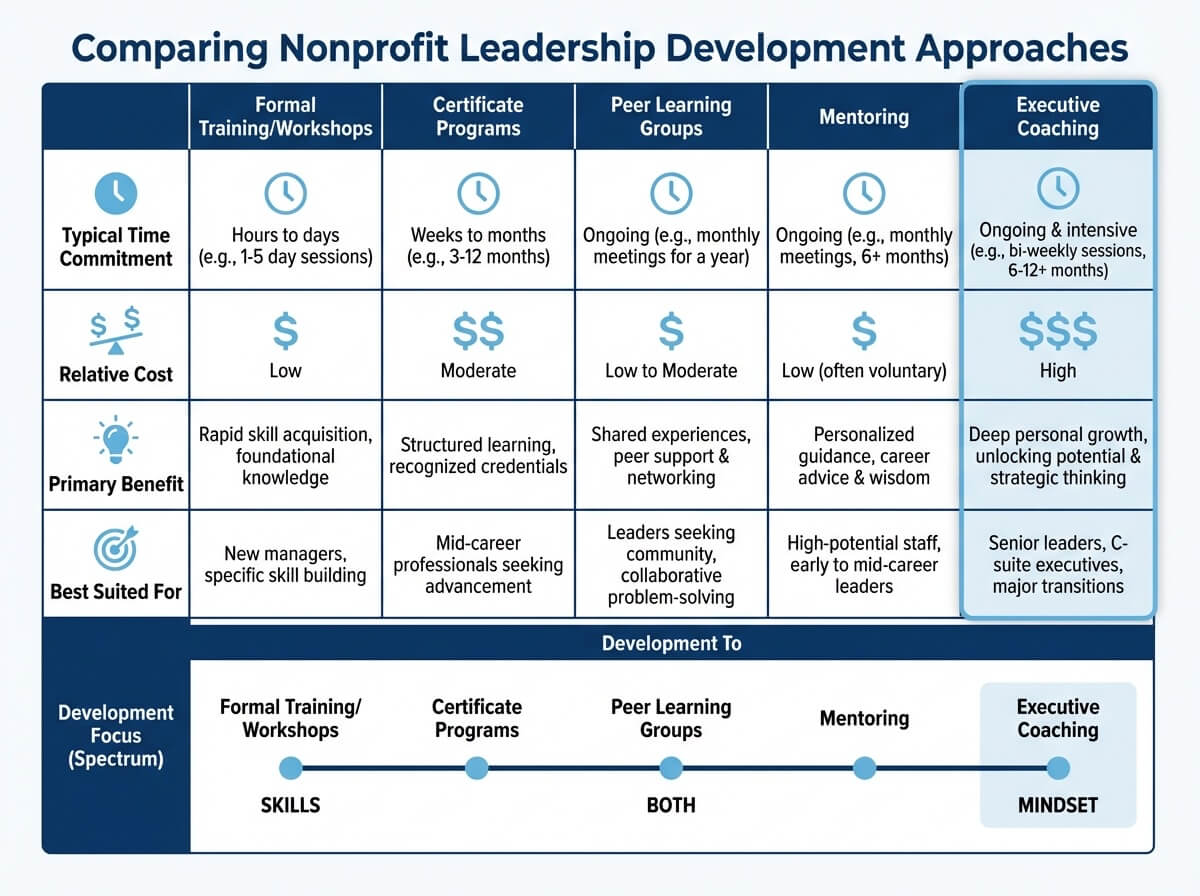
Nonprofit leadership development uses five approaches: training programs and workshops, certificate and degree programs, peer learning groups, mentoring, and executive coaching. Training builds knowledge. Coaching changes how a leader acts on it. In one public-agency study, training raised manager productivity 22.4 percent, and training followed by coaching raised it 88 percent.
Many executive directors learn the job by doing it. Of the 152 coaching applications CNPC received between January 2024 and February 2026, 15 percent came from leaders new to their role, and the most common reason for applying, named in 54 percent, was managing a team. A first-time executive director at a small North Carolina nonprofit wrote: “I’ve never run a nonprofit before. I am learning as I go, and I find myself questioning choices and next steps in ways I wouldn’t normally.”
Key Takeaways
- Pick the approach by the gap: training and certificates for knowledge, peer groups and mentors for perspective, coaching for behavior.
- In one public-agency study, training alone raised manager productivity 22.4 percent, while training followed by eight weeks of coaching raised it 88 percent.
- Only 30 percent of nonprofit C-suite roles were filled by internal promotion in Bridgespan’s 2015 survey, about half the for-profit rate.
- Succession planning works when managers at every level are developed years before anyone resigns.
- CNPC’s coaches volunteer, so six sessions of executive coaching cost $300 to $600.
Why Do Nonprofits Struggle to Develop Their Own Leaders?
At many nonprofits, development money comes after programs, so leaders learn on the job and senior roles often go to outside hires. In Bridgespan’s 2015 survey of 438 nonprofit C-suite executives, organizations had to fill 43 percent of their C-suite roles in the previous two years, and only 30 percent were filled by internal promotion, about half the for-profit rate.
At a small nonprofit, the executive director is often the HR department too, with none of the nonprofit leadership roles a larger organization spreads across a team. Our breakdown of what the job really is shows how much lands on one person. That is why preventing executive director burnout starts with support.
When Is Nonprofit Leadership Training the Right Choice?
Choose formal training when the gap is knowledge: reading a budget, running a board meeting, writing a fundraising plan. Workshops and short courses last hours to days. Prices run from free at NonprofitReady, which offers more than 600 free learning resources, to $7,750 for Harvard Business School’s six-day Strategic Perspectives in Nonprofit Management program.
By the Center for Creative Leadership’s 70-20-10 rule of thumb, leaders learn about 70 percent from challenging assignments, 20 percent from developmental relationships and only 10 percent from coursework. Our comparison of when nonprofits need coaching instead of training sets out where each fits.
Are Nonprofit Certificate and Degree Programs Worth It?
They are worth it for emerging leaders and career changers who need broad grounding and a credential employers recognize. Certificates take months and degrees take years, so they suit people with time to study. For a sitting executive director with an urgent problem, such as a strained board relationship, a general curriculum rarely reaches the specific issue.
If the budget or calendar rules a program out, a shelf of nonprofit leadership books covers much of the same ground, without the cohort or the credential.
What Does a Nonprofit Leadership Peer Group Offer?
A peer group gives an executive director colleagues at the same level who understand the job without explanation. Roundtables, association cohorts and facilitated mastermind groups meet regularly to compare problems and hold each other to commitments. They work best when members run organizations of similar size and the facilitator keeps the talk on decisions.
Isolation is one of the hardest leadership challenges of the role. The board employs the executive director, staff report to them, and local peers may compete for the same grants, as first-time executive directors tell CNPC. Peer advice has a limit, though: what worked at a large agency may not fit a three-person organization. Our guide to executive coaching for women nonprofit leaders looks at why peer support is often thin for women at the top.
How Is Mentoring Different From Coaching?
A mentor shares what worked in their own career. A coach asks questions that help the leader find what will work in theirs. Mentoring transfers experience at little or no cost, and it is strongest for career guidance and for reading an organization’s unwritten rules. It is weaker when the mentor’s organization, budget or community differs from the mentee’s.
Coaching Does What Mentoring Cannot
A mentor shares their experience. A coach helps you change how you lead. CNPC’s credentialed volunteer coaches work only with nonprofit leaders, starting at $300 for six sessions.
CNPC’s applicants often ask a coach for advice, yet the testimonials they write afterward describe a coach who helped them trust their own decisions. For a side-by-side view, see how coaching differs from mentoring.
Why Does Executive Coaching Change How Leaders Act?
Coaching works on the leader’s own goals in the leader’s own job, so new habits get practiced where they are needed. In a study of 31 managers at a municipal public agency, a training program raised productivity 22.4 percent, and eight weeks of one-to-one coaching after the training raised it 88 percent.
The study covered one public agency, so treat the exact gain with care. In CNPC’s coaching, each session ends with one or two commitments to try before the next, and six sessions can shift two or three specific patterns, such as handing decisions back to program directors or setting clearer expectations with the board chair. A coach can also help a leader notice a default style, such as deciding alone, and try other nonprofit leadership styles.
Our guide to what leadership coaching costs lists market rates. Every CNPC coach is credentialed by the International Coaching Federation and volunteers their time, so individual executive coaching costs $300, $400 or $600 for six sessions, usually over three to six months. The complete guide to nonprofit executive coaching explains how an engagement runs.
How Do You Choose the Right Approach?
Name the gap before you pick a program. If the leader lacks knowledge, choose training or a certificate. If they lack perspective or company, join a peer group or find a mentor. If they know what to do and keep not doing it, choose coaching. The strongest plans combine two or three, matched to career stage and budget.
- Emerging leaders: skills training, a mentor and the stretch assignments described in developing emerging nonprofit leaders.
- New executive directors: coaching in the first year, when many learn the role through trial and error. Boards can name that support in the executive director job description.
- Experienced leaders (several years as executive director or CEO): coaching plus a peer group.
- Founders preparing to hand over: coaching first, since a founder who cannot share decisions often shows signs of founder syndrome.
CNPC’s PATH model (Preparation and Application, Matching, Targeted Coaching, Holistic Monitoring) starts the same way: the application asks what the leader wants to work on before any coach is matched. A board that decides its executive director “needs training” before naming the problem often buys the wrong help. A leadership development plan template turns the choice into goals, a budget and dates.
Where Do Nonprofit Leadership Pipelines Break?
Pipelines break at promotions, when someone moves up and the habits that earned the move stop working. Four promotions deserve a plan: from individual contributor to first-time manager, from managing staff to managing managers, from department head to the executive team, and from the executive team to the executive director’s chair.
- First-time manager. The risk is that a strong individual contributor keeps doing the old work, because delegating feels like dropping it. Set expectations before the promotion and pair the new manager with an experienced one to think problems through.
- Manager of managers. The leader supervises managers as closely as they once supervised frontline staff, and friction follows. The shift is a new way of thinking about the job, which is why middle manager coaching tends to help more than another workshop.
- Department head to executive team. Decisions now need a view of the whole organization, even when that costs the department. Leading a cross-department project first is good rehearsal, and assessing your leadership pipeline can show whether any director is ready for this step.
- Executive team to executive director. Managing a board differs from managing staff, and outside representation becomes the main job. First-time executive directors who apply to CNPC name the board relationship, financial oversight and fundraising as their gaps.
Committee chairs and volunteer team leads make the same moves, and coaching for volunteer leaders applies the same method.

How Does Succession Planning Grow Out of Leadership Development?
Succession planning is what a working pipeline produces. When directors are already in development, a departure becomes a transition with internal candidates in the conversation. Bridgespan’s research names succession planning as the top organizational concern of nonprofit boards and chief executives, and development started years ahead is what answers it.
For every senior role, ask who could step in now, who could be ready in two years, and who in five. If the answer for any role is no one, fund that gap first. The board owns executive director succession: boards that support succession planning for executive directors and development below the top build resilience that survives any single leader’s departure. Boards that wait tend to run a crisis search with an interim executive director holding things steady.
A pipeline cannot guarantee an internal promotion, but it keeps internal candidates in the running and gives an outside hire a stronger bench. Before reading struggles as warning signs in an executive director, ask whether the leader ever had written expectations. If notice has arrived, start from a transition plan template and prepare interview questions for executive director candidates.
How Can a Small Nonprofit Pay for Leadership Development?
Start with the professional development line, which a board can write into the executive director contract so it survives a lean year. Then look for grants: some funders count leadership as part of capacity building for nonprofits, so read each funder’s guidelines. At CNPC, six coaching sessions cost $300 for organizations with operating expenses under $250K a year.
The price stays low because CNPC’s coaches donate their time: $400 from $250K to under $500K, $600 at $500K or more, and $500 to $1,100 for executive team coaching. When the gap is a skill nobody on staff has, such as setting up an accounting system, some funders pay for outside technical help. To make the case, use our playbook for building board support for executive director coaching.
This week, write down the leadership gap that costs your organization most and match it to one approach. If that is coaching, apply for coaching, which takes about five minutes, or start with the free guide to purpose-driven leadership.
Frequently Asked Questions
What is a nonprofit leadership pipeline?
It is the set of people inside the organization being prepared for the next level, from first-time managers to a possible executive director. It works when each person has a named next role, a development plan and someone who checks on progress.
How long does it take to build a leadership pipeline?
Years, not months. The first year maps who could step up and which promotions carry the most risk. Then comes steady development. A board that starts when the executive director resigns is already late.
What leadership skills do nonprofit leaders need most?
In 152 coaching applications to CNPC, the most common need was managing a team and staff (54 percent), followed by strategic planning (20 percent), change management (18 percent) and board relations (15 percent).
Is nonprofit leadership training enough on its own?
It is enough when the gap is knowledge, such as reading a financial statement. When a leader knows what to do and is not doing it, training alone rarely changes the habit. In a 1997 public-agency study, adding coaching after training roughly quadrupled the productivity gain.
How much does nonprofit leadership development cost?
From free to thousands of dollars. NonprofitReady offers free online courses, and the Harvard Business School nonprofit program costs $7,750. CNPC executive coaching costs $300 to $600 for six sessions because the coaches volunteer.
Ready to Close the Gap Between Knowing and Doing?
Training builds knowledge. Coaching changes behavior. CNPC pairs nonprofit leaders with ICF-credentialed volunteer coaches for six sessions starting at $300. The application takes five minutes.
Apply for Coaching →