

The Real Cost of Nonprofit Executive Coaching: Investment & Funding Guide
CNPC charges $300 to $1,100 for a six-session executive coaching engagement. Market-rate coaching starts at $300 per hour. That gap exists because 49 coaches donate their time. All of them are credentialed professionals. Eighty-one percent hold ICF credentials, including three Master Certified Coaches. The pricing reflects the model, not a discount on the services.
If you already know what nonprofit executive coaching involves, this article answers the question that follows: what does it cost, and how does your nonprofit pay for it? The numbers below are specific. CNPC publishes its exact pricing because nonprofit leaders making budget decisions need data, not ranges. This guide covers market-rate executive coaching costs, CNPC’s tiered pricing, five ways to fund coaching from your existing budget, the ROI evidence translated into nonprofit terms, and how to present the cost case to your board.
Key Takeaways
- Market-rate executive coaching costs $10,000 to $30,000 per engagement. CNPC charges $300 to $1,100 for six sessions because its 49 coaches donate their time.
- CNPC pricing tiers are based on organizational operating expenditures, not coaching quality. Every client is matched with an ICF-credentialed coach regardless of tier.
- Most nonprofits can fund coaching from an existing professional development line item, general operating support, or board-designated funds.
- No nonprofit-specific ROI study for coaching exists yet, but the directional evidence from corporate studies supports the investment at CNPC pricing levels.
- Coaching costs less than the alternatives boards already approve: executive searches ($30,000 to $60,000) and consultant engagements ($15,000 to $50,000).
What Executive Coaching Costs at Market Rate
Executive coaching fees at market rate range from $300 to $800 per hour for individual sessions. A typical coaching engagement runs 6 to 12 sessions over three to six months, putting total costs between $10,000 and $30,000 for most engagements. Premium executive coaching for senior leaders commands $500 to $1,000 per hour, with some packages exceeding $100,000.
The ICF Global Coaching Study, conducted with PricewaterhouseCoopers, surveyed coaching professionals across 161 countries and documented the pricing structure of the global coaching market. The Sherpa Executive Coaching Survey tracks year-over-year trends in engagement pricing and confirms that rates have held steady or increased over the past decade. Neither survey found a significant segment of credentialed coaches offering fees that most nonprofits could absorb.
Why does coaching cost this much? The credential investment alone explains part of it. An ICF Associate Certified Coach (ACC) has completed 60 or more hours of coach-specific training and logged 100 or more hours of coaching experience. A Professional Certified Coach (PCC) needs 125 hours of training and 500 coaching hours. A Master Certified Coach (MCC) needs 200 hours of training and 2,500 coaching hours. Years of supervised practice, continuing education, and mentor coaching hours sit behind every ICF credential. Coaches price their sessions to reflect that investment, and the business model works because corporate clients can absorb the cost.
Pricing models in the coaching industry vary. Some coaches charge hourly rates. Others sell packages of sessions at a set number, typically 6 or 12. Retainer models, where a client pays a monthly fee for ongoing access, are common at the executive level. The hourly model is the most transparent but often the most expensive, because each session is priced independently. Package pricing offers a modest discount but still results in total engagement costs well above $10,000 for credentialed coaches.
Nonprofit organizations cannot absorb these costs. A $300K-budget organization spending $15,000 on one person’s coaching engagement is allocating 5% of its entire operating budget. That calculation ends the conversation for most nonprofit leaders before they evaluate whether coaching would help.
Why Most Nonprofits Have Never Tried Coaching
Professional development budgets in the nonprofit sector typically run $500 to $2,000 per person per year. The Nonprofit HR workforce survey documents this consistently: organizations prioritize program delivery over staff development because funders and boards scrutinize overhead spending. At $10,000 or more per engagement, executive coaching sits far outside what most professional development line items can absorb.
The math is only part of the problem. Nonprofit leaders also face what amounts to a structural trap around funding categories. Most grant funding is restricted to specific programs. Coaching falls under general operating expenses, which are chronically underfunded across the sector. Even organizations with unrestricted revenue often face board pressure to keep overhead ratios low, and coaching for the executive director can look like a perk rather than an operational necessity.
The result is a double bind that plays out across the sector. Executive directors at small and mid-size nonprofits make the most consequential decisions in their organizations, often with the least structural support. They manage board relationships, staff performance, fundraising strategy, and program direction simultaneously. Their growth as leaders directly determines organizational outcomes for the communities they serve.
A large corporation invests tens of thousands in developing the leaders who hold those responsibilities. A nonprofit with a $400K operating budget may invest nothing, because the pricing structure of professional coaching was built for business organizations ten times their size. Understanding the full range of leadership development options available to nonprofit organizations reveals that coaching is one of several approaches, and the only one that addresses structural isolation directly. The executive coaching services that corporate leaders access routinely are invisible to most nonprofit leaders because the fees filter them out of the search results before they get past the first page.
The overhead anxiety compounds the problem. Boards and donors watch overhead ratios. An ED who proposes $15,000 for executive coaching may face the same scrutiny as a request for new office furniture: it reads as a management expense rather than a program investment. In practice, the leaders who would benefit most from coaching are the ones whose organizations are least equipped to fund it at market rates.
This is not a problem of willingness. It is a problem of pricing structure.
How CNPC’s Volunteer Model Changes the Math
CNPC operates on a three-part structure that separates the cost of coaching from the cost of coach compensation. Understanding this structure is key to understanding why the pricing is 85% or more below market rate without any reduction in coaching quality.
The 49 coaches on CNPC’s roster donate their coaching time. CNPC provides the infrastructure: intake, matching, quality monitoring, and outcome tracking. The client organization pays an operations fee that covers CNPC’s administrative costs. No portion of the fee goes to coach compensation.
The coaches are not students or trainees. Eighty-one percent hold ICF credentials: 3 MCCs, 15 PCCs, and 20 ACCs. These are professionals with years of coaching practice who choose to donate their time to nonprofit leaders. They do this because they have built successful careers and want to give back to organizations doing work that matters. Volunteer does not mean unqualified. It means the pricing is disconnected from coach compensation, which is what makes six sessions with a credentialed coach available for $300 instead of $10,000.
Independent Sector publishes the estimated dollar value of a volunteer hour annually, which provides context for the scale of what CNPC’s coaches contribute. But the more relevant framing is practical: clients at CNPC receive the same caliber of coaching that corporate executives pay $300 to $800 per hour to access. The coaching process is the same. The CNPC executive coaching program follows the PATH model with structured intake, matched coach assignment, six sessions, and outcome monitoring. The pricing reflects the model, not a reduction in quality.
The model breaks an assumption that normally holds in professional services: that lower price means lower quality. In CNPC’s case, the pricing is disconnected from the coach’s skill level entirely. A $300-tier engagement may be delivered by an MCC with 3,000 hours of coaching experience, because that coach donates their time to every client regardless of the fee. The fee covers CNPC’s operations. The coaching itself is donated.
You can read more about how CNPC keeps coaching affordable through the volunteer model in the full explanation.
CNPC Pricing: What You Actually Pay
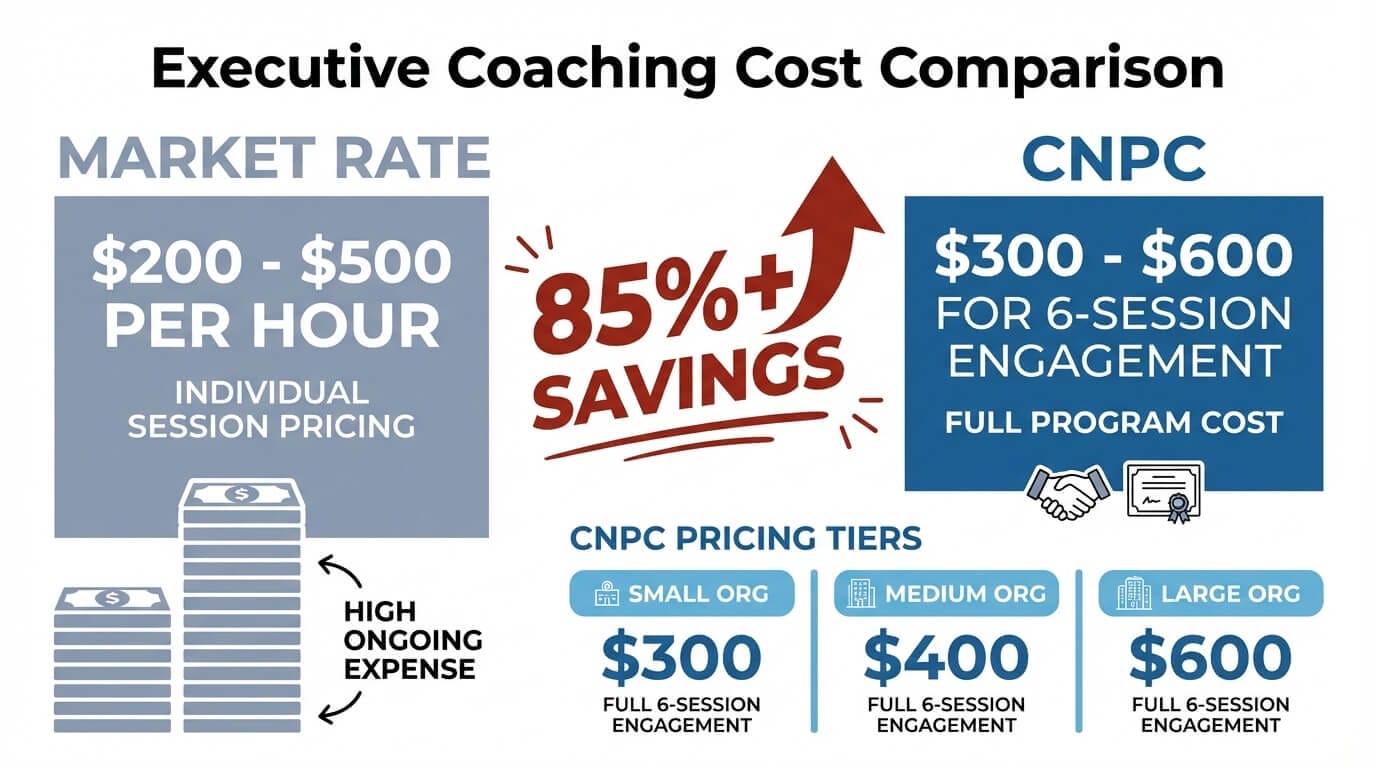
CNPC charges three pricing tiers based on annual operating expenditures, ranging from $300 to $1,100 per six-session engagement. No hidden fees, no tiered service quality. Every client gets matched with an ICF-credentialed coach regardless of which tier applies to their organization. The tiers reflect capacity to pay, not depth of coaching.
| Org Size | Annual OpEx | Individual (6 sessions) | Team (6 sessions) |
|---|---|---|---|
| Small | Under $250K | $300 | $500 |
| Medium | Under $500K | $400 | $700 |
| Large | $500K+ | $600 | $1,100 |
Team coaching for nonprofit leadership teams follows the same tiered structure for organizations that want to develop their leadership group together rather than coaching a single leader. Team coaching addresses dynamics that individual coaching cannot: decision-making processes across the senior leadership team, communication patterns between departments, and collective accountability for organizational goals.
For context: $300 for six coaching sessions is less than most organizations spend sending one person to a two-day conference. There is no difference in coaching quality between tiers. A $300-tier client receives the same credentialed, matched coaching as a $600-tier client. The fee reflects the organization’s capacity to pay, not the depth of the service delivered. The tiers exist so that a $150K grassroots organization and a $5M regional nonprofit both have access, at a price point appropriate to their operating budget.
CNPC’s intake data from 152 applications over 25 months shows a bimodal distribution: 51% of applicants are large organizations at the $600 tier, and 41% are small organizations at the $300 tier. Both groups access the same roster. One large nonprofit purchased 13 individual coaching engagements over two years at $300 per person, paying $3,900 total for what would cost over $130,000 at market rates. For organizations with multiple leaders who need coaching, the math becomes even more favorable.
Apply now. CNPC’s pricing is public. No sales call required.
How to Fund Coaching From Your Existing Budget
At $300 to $600 for individual coaching, the funding question is not whether coaching is affordable. It is which budget line covers it. Five funding paths that CNPC applicants have used, ordered from most common to least common based on intake patterns.
- Professional development line item. The most straightforward path. Most nonprofits already carry a professional development allocation, even if it is modest. At CNPC’s pricing, six sessions of executive coaching fits within the same line item that covers conference registrations and online courses. If your PD line item has $300 to $600 unallocated, coaching is funded. For detailed guidance on budgeting for coaching in your nonprofit, the budgeting article walks through the process step by step.
- General operating support. Unrestricted grants and general operating revenue cover administrative expenses, and coaching qualifies as an organizational cost. Organizations that receive multi-year general operating grants from foundations can often include coaching under staff development or organizational capacity without requiring a separate line item. If your organization has unrestricted revenue, the $300 to $600 coaching fee fits comfortably alongside other operating expenses your board already approves.
- Board-designated funds. Some boards maintain a discretionary fund or reserve for ED development. Boards that have initiated coaching applications at CNPC have used this mechanism: the board chair approves a $400 or $600 expenditure from the board’s discretionary allocation. The Q4 fiscal year-end period is when most of these approvals happen, aligning with budget cycle timing and annual performance reviews.
- Capacity building grants. Foundation program officers increasingly view coaching as a capacity-building investment. Grantmakers for Effective Organizations tracks the growth of capacity-building funding across the philanthropic sector. The language in grant proposals matters: “executive coaching for organizational leadership capacity” gets funded. “Coaching for the ED” often does not. Use the grant budget template and sample grant language to include coaching in your next capacity-building proposal.
- In-kind matching. Some foundations match in-kind contributions. The volunteer coach’s donated time is technically an in-kind contribution to the client organization. Depending on the funder’s matching policies, this in-kind value may qualify for matching funds that offset or cover the operations fee entirely.
“I will be covering this cost out of my own pocket as we can’t afford the fee. We have a $100K budget with three highly underpaid part-time staff members including myself.” Executive director, small nonprofit, Michigan
That quote comes from a real CNPC application. Some leaders pay out of pocket because their organization has no professional development allocation at all. Others have described the discovery of CNPC as a turning point: “I am so grateful to have found this program, as my previous searches for coaching have been far out of the scope of resources of our organization or my own pockets.”
CNPC does not recommend out-of-pocket payment as the primary path. If your organization cannot fund $300 from its operating budget, the first conversation with your coach may well focus on building the case for why a professional development line item should exist. The goal is to make coaching a sustainable organizational investment, not a personal expense.
The ROI Evidence for Nonprofit Coaching
Two studies are cited in nearly every article about executive coaching returns, and both come from corporate contexts. Naming them with full attribution matters because the ROI numbers are routinely stripped of context and turned into marketing claims that mislead nonprofit budget holders.
The Manchester Group studied executive coaching outcomes in Fortune 100 companies and found a 529% return on investment. The study measured productivity gains, quality improvements, organizational strength, customer satisfaction, and reduced complaints. The MetrixGlobal study, which included a control group, put the return at 788%. Both studies are over twenty years old. Both studied corporate executives, not nonprofit leaders.
No equivalent study exists for the nonprofit sector. That is an honest limitation. CNPC is building outcome tracking through its Holistic Monitoring phase, but aggregate nonprofit-specific ROI data does not yet exist anywhere in the field. The directional evidence is strong. The specific multipliers should not be applied to nonprofit contexts without translation.
What the corporate evidence does suggest, translated into nonprofit terms:
ED retention. Replacing a nonprofit executive director costs $30,000 to $60,000 when you account for search fees, interim leadership, and organizational disruption. A $600 coaching engagement that contributes to an ED staying one additional year represents a return that justifies the investment on retention alone.
Board relationship quality. Coaching consistently surfaces communication patterns between the ED and the board that, left unexamined, lead to governance conflict. Fewer emergency board meetings and clearer role boundaries reduce organizational risk.
Fundraising performance. An ED who delegates effectively and manages their own capacity well spends more time on development and donor relationships. The connection between coaching and fundraising results is indirect but consistent in the qualitative evidence.
Staff retention. Organizations led by better-supported EDs have lower staff turnover. The cost of replacing a mid-level nonprofit employee runs $10,000 to $20,000. If coaching improves the ED’s management approach enough to retain one staff member, the engagement has paid for itself several times over.
You can calculate your coaching ROI using CNPC’s interactive tool to model the numbers for your organization’s specific situation. For a broader look at the benefits that justify the investment, the full evidence review covers both quantitative and qualitative outcomes.
“I grew as a leader, manager, teammate, and person through coaching with CNPC. The framework and thoughtful coaching guided me towards decision making that made for a stronger organization.” Emily F., nonprofit leader
Sixty-three percent of CNPC applicants found the program through Google search, which suggests that nonprofit leaders are actively looking for coaching and finding that most results describe executive coaching services priced for corporate budgets. The search itself is evidence of demand. The gap is access, not interest. Nonprofit leaders know coaching could help. They have been told, repeatedly, that they cannot afford it. At $300 to $600 for a full engagement, the math changes.
Making the Case to Your Board
The most important reframe for a board presentation: coaching is organizational infrastructure, not a personal perk. Board members have fiduciary responsibility for the organization’s leadership capacity. They respond to risk mitigation and organizational performance metrics. A personal growth narrative does not move a finance committee. A cost comparison does.
Three numbers tell the story. An executive coaching engagement through CNPC costs $300 to $600 depending on the organization’s operating budget. An executive search to replace a departing ED costs $30,000 to $60,000. A consultant engagement to address the same organizational challenges a coach might surface costs $15,000 to $50,000. Coaching is the lowest-cost, lowest-risk option of the three, and it is the only one that builds the existing leader’s capacity rather than replacing them or outsourcing the thinking.
Boards typically ask three questions when evaluating a coaching proposal.
First: where does the money come from? The funding section above covers five mechanisms, starting with the professional development line item that most organizations already carry.
Second: how do we know it works? The ROI evidence provides directional data from corporate studies, with honest caveats about their context. CNPC’s own outcome tracking through the Holistic Monitoring phase builds nonprofit-specific evidence over time.
Third: what if it does not work? Six sessions is a bounded investment with clear evaluation points. CNPC conducts a mid-engagement check-in and a closing debrief. A $600 coaching engagement that produces limited results has cost the organization less than a single day of consultant time. The financial exposure is minimal. The potential upside, a more effective leader making better decisions across the organization, is significant.
Some boards initiate the coaching conversation themselves. In CNPC’s intake data, board chairs have submitted applications on behalf of their executive directors, framing the request in governance language: “strengthening executive ownership of outcomes” or “supporting the ED through a growth phase.” If your board is not yet at that point, the pitch works best when it comes from the board development committee or, if no development committee exists, the executive committee.
Present coaching alongside the cost of the alternatives. Frame the $300 to $600 expenditure against the $30,000 to $60,000 cost of an executive search. Board treasurers understand risk-adjusted investments. A six-session coaching engagement is a bounded commitment with clear evaluation points. It is not an open-ended expense. For a complete walkthrough of presenting coaching to your board, the board guide for executive director coaching covers sample language, common objections, and evaluation frameworks.
How CNPC Compares to Other Options
Four categories of coaching providers serve or could serve nonprofit leaders. None are named here because the comparison is structural, not competitive. Each category has legitimate strengths, and CNPC’s advantage is a specific combination of pricing, credentials, and nonprofit focus that no other category offers.
Market-rate individual coaches charge $300 to $800 per hour. Engagements run $10,000 to $30,000. Coach quality is high. Nonprofit specialization is rare. Most market-rate coaches built their practices serving corporate clients and may not understand the governance dynamics, funding constraints, or mission-accountability structures that define nonprofit leadership. The price point excludes most nonprofits entirely.
Corporate coaching platforms offer lower-cost coaching through digital tools, group coaching sessions, or AI-augmented programs. Pricing models vary from $200 to $500 per month for subscription-based access. The coaching is general-purpose leadership coaching designed for business professionals in corporate environments. Nonprofit-specific context, including board governance dynamics, restricted-funding challenges, and the particular pressures of mission-driven work, is not part of the platform design. For a nonprofit ED dealing with a board conflict or a restricted-funding challenge, general-purpose coaching may miss the mark entirely.
Nonprofit-focused consultancies offer coaching alongside consulting, training, and capacity-building services. Engagement pricing runs $6,000 to $12,000 per year. The nonprofit focus is genuine, and the organizational understanding is often strong. But the bundling of services means coaching may not be the primary expertise. Coaches at these organizations may or may not hold ICF credentials. The pricing, while lower than market-rate individual coaching, still exceeds what most small and mid-size nonprofits can allocate for a single person’s development.
CNPC (volunteer model): $300 to $1,100 per six-session engagement. ICF-credentialed coaches (81% of the roster). Nonprofit-exclusive focus. The volunteer model breaks the typical relationship between coaching quality and coaching cost. The honest limitations: a 49-coach roster means matching depends on availability. Response time is two weeks, not two days. Pricing tiers are fixed. For organizations that need immediate, intensive coaching at a weekly cadence over many months, market-rate coaching with a private practitioner may be more appropriate. CNPC serves organizations that need six sessions of structured coaching at a price that does not distort their budget. For a deeper look at affordable coaching models across the sector, the full comparison covers how different delivery structures affect both cost and outcomes.
CNPC serves organizations that need six sessions of structured coaching at a price that does not distort their budget.
The application takes five minutes. You describe your organization, your role, and the goals you want coaching to address. CNPC reviews every submission and responds within two weeks. If your organization is a fit, we confirm your pricing tier based on operating expenditures, match you with an ICF-credentialed coach whose experience aligns with your situation, and schedule your first session.
$300, $400, or $600 for individual coaching. $500, $700, or $1,100 for team coaching. Six sessions delivered virtually over three to four months. The process is at cnpc.coach/apply.
Apply Now for Executive Coaching
Our volunteer coaches work exclusively with nonprofit leaders. Six coaching sessions tailored to your goals, starting at $300.
Apply for Coaching →