

Nonprofit Leadership Development: A Practical Guide to 5 Approaches That Work
What are effective approaches to nonprofit leadership development?
Five approaches exist: formal training programs, certificate and degree programs, peer learning cohort groups, mentoring relationships, and executive coaching. Training alone improves manager productivity 22 percent. Training combined with coaching improves it 88 percent. Coaching produces the strongest evidence base for behavior change because it targets how leaders think and act, not just what they know.
Nonprofit leaders manage some of the most complex organizational challenges in any sector. A single executive director may oversee board governance, fundraising, program delivery, compliance, staff management, and volunteer coordination simultaneously. Yet according to Bridgespan Group research, the nonprofit sector invests less in leadership development training per capita than virtually any other field. The people making the hardest decisions get the least structured support for making them.
The gap is structural, not individual.
Funders fund programs, not people. Boards approve program budgets, not professional growth budgets. The National Council of Nonprofits has documented this pattern for years: when budgets tighten, the professional development line is the first to be cut. The result is a generation of nonprofit leaders who are self-taught by necessity, not by choice. And the organizational cost of that underinvestment shows up in turnover, burnout, and mission drift. For many executive directors, the path to preventing executive director burnout starts with receiving the kind of development support that their for-profit counterparts take for granted.
Five distinct approaches to nonprofit leadership development exist. They serve different needs, cost different amounts, and produce different results. Most nonprofit leaders have tried one or two. Few have considered all five, and fewer still have encountered the one with the strongest evidence base for individual behavior change: executive coaching for nonprofit leaders.
Key Takeaways
- Five development approaches serve different needs: training, certificates, peer groups, mentoring, and coaching. Choosing the right one depends on your career stage, budget, and whether you need knowledge or behavior change.
- Training alone improves productivity by 22%. Training combined with coaching improves it by 88%. The gap between knowing and doing is where coaching operates.
- Most nonprofit leaders have never tried executive coaching because market rates start at $6,000 per engagement. Volunteer-coach models like CNPC’s make coaching available at $300 to $1,100 for six sessions.
- The most effective leaders combine two or three development approaches, with coaching as the anchor that builds the capacity to apply everything else.
- Leadership development is not just for the executive director. Organizations that invest across all levels build the pipeline that prevents succession crises.
The Nonprofit Leadership Gap
Bridgespan’s research on the nonprofit leadership pipeline found that 43% of nonprofit C-suite leaders turn over within five years, and only 30% of senior roles are filled through internal promotion. The sector loses institutional knowledge faster than it builds it. Nonprofit executive director statistics quantify the turnover rates driving that gap across organization sizes and leadership stages.
Coaching Does What Mentoring Cannot
A mentor shares their experience. A coach changes how you lead. CNPC’s volunteer coaches are ICF-credentialed professionals who work exclusively with nonprofit leaders, starting at $300 for six sessions.
These numbers point to a funding paradox. Foundations and individual donors fund programs and services because outcomes are visible and measurable. Leadership development is invisible until its absence becomes a crisis. When the executive director burns out and leaves, the board spends $30,000 to $60,000 on an executive search to replace someone they could have supported for a fraction of that cost.
The post-pandemic period accelerated every underlying trend. Nonprofit HR’s workforce surveys have documented rising turnover rates, shrinking applicant pools for senior roles, and professional development spending that remains flat even as operational complexity increases. Hybrid work, digital transformation, expanded compliance requirements, and donor expectations that shift faster than strategic plans can accommodate: all of these land on the executive director’s desk.
A generational leadership transition compounds the challenge. Long-serving executive directors who built organizations over two or three decades are retiring. The leaders replacing them often arrive with strong program expertise but limited executive-level experience in managing boards, overseeing financial operations, or leading through organizational change. Without structured development, these new leaders learn through trial and error, absorbing the cost of mistakes that development could have prevented. Boards can shorten that learning curve by naming first-year support, including coaching, in the executive director job description and the offer.
Small nonprofits face a compounded version of this problem. At an organization with a $250K operating budget, the executive director is often the entire leadership team. There is no chief operating officer, no deputy director, no vice president of programs to absorb overflow: none of the nonprofit leadership roles a larger organization spreads across a team. Every management challenge, every board question, every staff conflict routes to one person. Our breakdown of what the job really is at a small nonprofit covers the five areas it spans. Professional development for that person is not a perk. It is organizational risk management.
Boards that do not invest in their executive director’s development are making an implicit bet: that their current leader will figure out everything alone, indefinitely. For some leaders, that bet pays off for a while. For most, it produces a slow accumulation of reactive decision-making, deferred strategic thinking, and the kind of chronic overwork that eventually forces a resignation letter. Boards sometimes read that slide as warning signs in an executive director, when the first question is whether the leader ever had written expectations and support. The cost of replacing that leader is likely to exceed the cost of developing them.
Replacing a burned-out leader usually costs more than developing one would have. That is not a people problem. It is a budget-line problem.
Five Approaches That Work
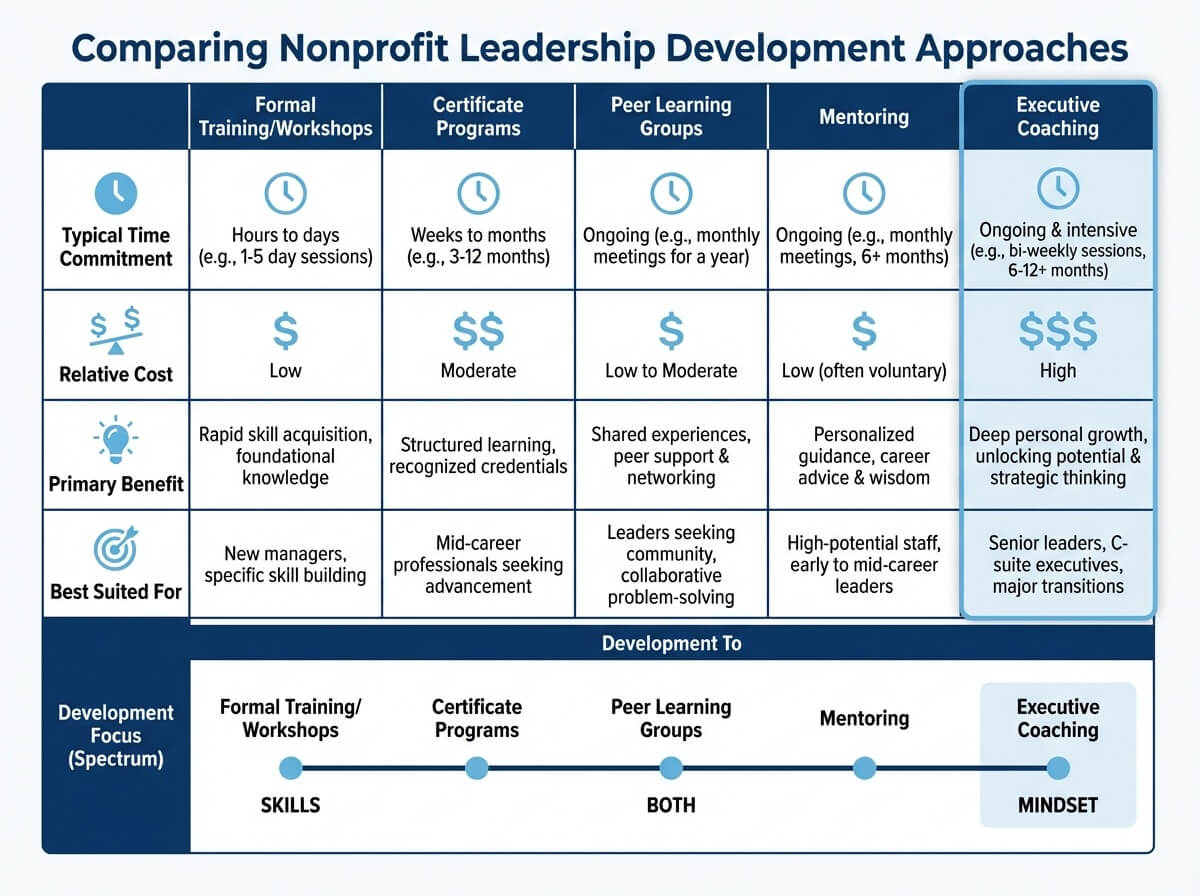
Nonprofit leadership development training falls into five distinct categories: formal training programs and workshops, certificate and degree programs, peer learning and cohort groups, mentoring relationships, and executive coaching. Each approach develops leaders differently, and understanding those differences matters more than choosing the one with the best reputation or the lowest price.
Two axes separate the five approaches. The first is the type of development they produce: knowledge acquisition on one end, behavior change on the other. Training and certificates build what you know. Coaching changes how you think and act. The second axis is cost and time commitment, which ranges from free mentoring relationships to $80,000 graduate degrees.
The question is not “which approach is best.” It is “which is best for your situation right now.” A mid-career executive director who already has the knowledge needs behavior change, not another certificate. An emerging leader who has never managed a budget needs skills training before anything else. The sections that follow give an honest assessment of each approach, including the limitations that program marketing materials tend to leave out.
Training Programs and Workshops
Formal training programs are the most familiar development approach for nonprofit leaders. Structured learning experiences lasting one to five days cover specific skills: financial management, fundraising strategy, strategic planning, board governance, and program evaluation. Providers range from university executive education programs (Harvard Kennedy School, Stanford GSB, Bryn Mawr’s NELI program) to state nonprofit associations, infrastructure organizations, and online platforms like NonprofitReady.org.
The strengths are real. A well-designed training program builds specific, transferable knowledge. It provides credentials that matter for career advancement. The cohort experience creates peer networks that last beyond the program itself. For leaders who need foundational management skills, training programs deliver.
The cost range is wide: free for online platforms, $3,000 to $8,000 for most substantive multi-day programs, and $14,000 or more for elite university executive education. Add travel, lodging, and the cost of the executive director being away from operations, and the total investment can exceed what many small nonprofits allocate for professional development in an entire year.
The deeper limitation is not cost. It is the gap between knowledge and behavior. Harvard Business Review research on leadership development has documented what practitioners call the “Monday morning problem”: leaders return from training with excellent new knowledge and walk back into the same environment, the same habits, and the same pressures that shaped their old patterns. Without support for applying what they learned, most leaders default to prior behavior within weeks.
Bridgespan’s leadership development model frames this as the 70-20-10 principle: roughly 70% of leadership development happens through on-the-job experience, 20% through relationships (coaching, mentoring, peer learning), and 10% through formal instruction. Training programs address the 10%. That 10% matters. But it is 10%.
For leaders whose primary gap is knowledge, training is the right choice. For leaders when nonprofits need coaching instead of training, the answer is different.
Certificate and Degree Programs
Certificate and degree programs represent the most intensive form of structured learning. Multi-month programs from universities and professional associations offer credentials in nonprofit management, nonprofit leadership, social enterprise, and related fields. Some are fully online, some residential, some hybrid.
The value proposition is depth. Certificate programs provide the deepest knowledge acquisition of any development approach. The credential itself carries weight for career advancement, particularly for leaders transitioning into the nonprofit sector from corporate or government roles. Cohort-based programs create professional networks that persist for years. Many include structured mentoring as part of the curriculum.
Cost is the primary barrier. Certificate programs run $3,000 to $15,000. Graduate degrees in nonprofit management or public administration range from $30,000 to $80,000. Some fellowship and scholarship options exist, but they are competitive and limited. Time commitment adds another layer: three to twelve months for certificates, two to three years for degrees. For an executive director at a $200K grassroots organization who cannot step away from operations for extended periods, these programs are functionally inaccessible.
There is also a fit question. Certificate programs are designed for the sector broadly, not for a specific leader’s specific situation. The executive director who needs to rebuild a fractured board relationship or learn to delegate after years of doing everything alone will not find that in a curriculum built for general nonprofit management. The knowledge is valuable. Whether it addresses the leader’s actual development need depends on what that need is.
Certificate programs are strongest for emerging leaders building foundational expertise, professionals entering the nonprofit sector, and organizations investing in long-term leadership development for staff members with high potential.
Peer Learning and Cohort Groups
Peer learning groups address a problem that nonprofit leaders rarely name directly: isolation, one of the hardest leadership challenges of the job. Executive directors often have no peer at their level within their own organization. The board is above them, the staff is below them, and the strategic decisions land on them alone. That isolation often runs sharpest for women at the top of nonprofit organizations, which is why executive coaching for women nonprofit leaders has emerged as its own focus area. CEO roundtables, mastermind groups, and professional association cohorts create a structured space where leaders share challenges, test strategies, and hold each other accountable.
These groups work. The shared context reduces the time spent explaining basics. When five executive directors sit in a room and one describes a board conflict, the other four already understand the dynamics. Peer accountability structures create follow-through that solo reflection rarely produces. And the cost is low relative to formal programs: free through some membership organizations, $1,000 to $5,000 per year through facilitated cohorts.
Quality depends entirely on facilitation and group composition. A poorly facilitated group becomes a venting session where members commiserate about shared problems without developing strategies to address them. Peer advice is experience-based, not evidence-based, and what worked at one organization may fail at another. Group dynamics sometimes prevent the kind of honest, vulnerable conversation that produces real growth. And peer groups provide no individualized attention to the specific leader’s specific situation.
Groups work best when all members are at roughly the same organizational scale. An executive director running a $200K grassroots organization has functionally different challenges than one running a $5M regional institution, even if both titles say “Executive Director.” The best cohort programs account for this and group members by budget size, mission area, or leadership tenure.
Peer advice is experience-based, not evidence-based. What rescued one organization may wreck another operating at a different scale with a different board.
Peer learning is strongest for experienced leaders who already have foundational knowledge and need perspective, accountability, and community. It is less effective for emerging leaders who need structured skill building or for leaders facing challenges that require individualized support rather than group wisdom.
Mentoring Relationships
Mentoring is the oldest form of leadership development, and in many nonprofits it happens informally without anyone calling it that. A more experienced leader provides guidance, career advice, and institutional wisdom to a less experienced one. Formal mentoring programs match mentors and mentees through an organization. Informal mentoring develops organically through professional networks. Reverse mentoring, where emerging leaders mentor senior leaders on specific topics like technology or community engagement, is gaining traction in the sector.
The strengths are genuine. Mentoring transfers knowledge that no training program can teach: how to read a board room, when to push back on a funder’s request, what the first ninety days in a new executive director role actually look like. The cost is zero or near-zero. Intergenerational connections strengthen the sector’s overall leadership capacity.
The limitation is structural. Mentoring is advice-driven, not behavior-change-driven. A mentor shares what worked in their situation. That experience may not transfer to the mentee’s context, especially when organizational size, mission area, or community dynamics differ significantly. Power dynamics between mentor and mentee can limit honest conversation. And there is no structured accountability for outcomes. A mentoring relationship produces as much or as little as the two individuals put into it.
The distinction between mentoring and coaching is worth stating clearly. A mentor says “here is what I did in that situation.” A coach asks “what assumptions are you making about that situation?” Both are valuable. They do different things. For a detailed comparison, see our guide on how coaching differs from mentoring.
Executive Coaching
Executive coaching is a structured, individualized engagement between a trained coach and a leader, focused on the leader’s own goals. The coach does not advise, consult, or mentor. The coach asks questions that surface assumptions the leader did not realize they were making, and supports the development of new patterns of thinking and action. Coaches are credentialed through the International Coaching Federation at three levels: ACC (Associate), PCC (Professional), and MCC (Master), each requiring progressively more training hours and supervised coaching experience.
The evidence base for coaching is stronger than for any other individual development method. The Manchester Group’s study of Fortune 100 executives found a 529% return on coaching investment. A MetrixGlobal Associates study that included a control group measured 788% ROI. The most telling data point comes from a study by Gerald Olivero, K. Denise Bane, and Richard Kopelman published in Public Personnel Management: training alone improved manager productivity by 22%, while training combined with coaching improved it by 88%. The ICF/PricewaterhouseCoopers Global Coaching Study found that 86% of organizations reported positive ROI from coaching investments. Our review of executive coaching benefits translates this research into nonprofit-specific outcome areas.
These studies measured corporate executives. No equivalent large-scale study exists for the nonprofit sector. But the mechanism is transferable: coaching works by changing how a leader thinks and acts, and that mechanism does not vary by tax status. Consider a community health nonprofit that sent their executive director to a $5,000 university certificate program. The executive director returned with excellent strategic planning knowledge but changed nothing about the daily pattern of reactive firefighting. The strategic planning knowledge was always there. What the executive director needed was the space to examine why three staff positions had gone unfilled for eighteen months and the support to stop absorbing everyone else’s responsibilities. That is coaching’s territory. The organizational complement to that individual coaching work is building organizational calm: the decision frameworks, communication norms, and meeting discipline that keep the reactive patterns from regenerating once coaching ends.
Training addresses what leaders know. Coaching changes what leaders do. The 22% vs. 88% productivity gap is the distance between those two outcomes.
Coaching’s strengths are precisely what the other four approaches lack. It is individualized to the specific leader’s specific challenges. It is behavior-change-oriented, not just knowledge-transfer. It works toward goals the leader sets at the start, over an engagement that typically runs three to six months. And it creates lasting shifts in how a leader approaches decisions, delegation, conflict, and strategic thinking. Coaching is also a practical way to widen your range across nonprofit leadership styles, because a habit is hard to see from inside it. For a deeper look at how coaching works in the nonprofit context, see the complete guide to nonprofit executive coaching.
The barrier has always been cost. Market-rate executive coaching runs $200 to $500 per hour, with full engagements costing $6,000 to $30,000. For a complete breakdown of what leadership development coaching costs, including funding options, see our cost guide. At those prices, coaching has been effectively absent from the nonprofit leadership development conversation. It is the approach with the strongest evidence that most nonprofit leaders have never tried.
The exception to the price barrier is the volunteer-coach model. CNPC’s coaches are ICF-credentialed professionals who donate their coaching time to nonprofit leaders. The pricing for individual executive coaching through CNPC runs $300 to $1,100 per six-session engagement, determined by the organization’s operating budget. That is not a discount on quality. Eighty-one percent of CNPC’s coaching roster holds ICF credentials, including three Master Certified Coaches. The pricing reflects the model.
How to Choose the Right Approach
Knowing the five approaches matters less than knowing which one fits your situation. Three lenses help narrow the decision: career stage, budget, and the specific type of development gap you need to close.
By Career Stage
- Emerging leaders (program directors, first-time managers): formal training and mentoring. Build foundational skills and institutional knowledge before adding approaches that require experience to be effective.
- Mid-career leaders (2 to 5 years as executive director or CEO): coaching and peer learning. The knowledge base exists. The need is behavior change, strategic thinking, and peer accountability.
- Senior leaders (5+ years, established): coaching and peer groups. The focus shifts to succession, avoiding stagnation, and developing executive directors who can sustain impact over the long term.
- Leaders in transition (new role, founder handoff, organizational crisis): coaching as the primary intervention. Transitions are behavior-change moments, not knowledge-gap moments. A founder who cannot share decisions often shows the signs of founder syndrome long before any handoff.
By Budget
- $0: Mentoring (find one through your state association or professional network), free online training (NonprofitReady.org, state association workshops), and on-the-job stretch assignments that deliberately expand the skills the leader practices.
- $300 to $1,100: Coaching through CNPC. Six sessions with an ICF-credentialed volunteer coach, priced by organizational operating budget. This is where the strongest value-for-development-dollar exists in the sector.
- $3,000 to $8,000: Formal certificate programs, paid peer cohorts, or market-rate coaching. Effective if the leader has both the time and the budget.
- $8,000+: University executive education, executive MBA programs, or extended private coaching engagements.
By Development Need
| Approach | Best For | Time | Cost Range | Focus | Behavior Change? |
|---|---|---|---|---|---|
| Training/Workshops | Knowledge gaps | 1-5 days | Free to $14,000+ | Skills | Low |
| Certificate Programs | Career advancement | 3-12 months | $3,000-$15,000+ | Credentials | Low-Medium |
| Peer Learning Groups | Isolation, accountability | Ongoing | Free to $5,000/yr | Perspective | Medium |
| Mentoring | Career guidance, wisdom | Ongoing | Free | Experience | Low |
| Executive Coaching | Behavior change, strategy | 3-6 months | $300-$30,000 | How you lead | High |
One common mistake: treating all development approaches as interchangeable and choosing based on convenience or brand recognition rather than matching the approach to the actual developmental need. An executive director who attends three conferences a year but never works with a coach or mentor is investing in the same 10% of the development spectrum repeatedly. Another frequent pattern is investing development budget exclusively in the executive director while middle management receives nothing, which creates the succession vacuum discussed in the next section.
The combination principle matters most. The most effective nonprofit leaders do not rely on a single development approach. They combine two or three, using coaching as the anchor that builds their capacity to apply everything else: the training they attended, the advice their mentor gave, the strategies their peer group suggested. A leadership development plan template can help structure this combination for your specific goals and budget.
Building a Leadership Pipeline
Everything above addresses individual development. But organizations that invest only in the executive director create a single point of failure. When that executive director leaves, and eventually every executive director does, the organization scrambles to fill a role that no one else was being prepared to hold, often by hiring an interim executive director to steady things during the search.
Building your nonprofit’s leadership pipeline requires development investment at every organizational level, not just the top. The Annie E. Casey Foundation’s work on nonprofit leadership pipelines has shown that organizations with intentional development strategies at multiple levels recover faster from leadership transitions, retain staff longer, and deliver more consistent program outcomes.
Middle management is the most neglected level. Program directors, development directors, and operations managers are the people most likely to become the next executive directors. Yet they receive the least development investment in most nonprofits. Middle management development is where the pipeline either builds or breaks. These leaders need management skills training, mentoring from senior staff, and increasingly, their own coaching engagements focused on the transition from managing programs to leading organizations.
Developing emerging nonprofit leaders starts earlier than most organizations realize. Staff members who show initiative, take ownership of cross-functional projects, and build relationships across the organization are signaling leadership capacity. Investing in their development through training, stretch assignments, and mentoring creates a bench that the organization can draw from when senior roles open.
Organizations that invest only in the executive director are building a leadership strategy with a single point of failure.
Consider a regional advocacy organization with three program directors. Instead of sending all three to formal training, the organization invested in a peer cohort for shared learning and individual coaching for the director identified as the likely next executive director. When the executive director retired two years later, the transition took six weeks instead of the typical six months. The successor had already built the decision-making patterns and board relationships the role required.
In volunteer-heavy organizations, leadership development extends beyond paid staff. Volunteer coordinators, committee chairs, and program volunteers who manage other volunteers need leadership skills too. Coaching for volunteer leaders is an emerging practice that strengthens the entire organizational ecosystem.
BoardSource research on board investment in executive development reinforces a critical point: the board’s role in leadership development is not limited to approving the executive director’s professional development budget. Boards that actively support succession planning for executive directors and invest in development across the organization’s leadership tiers are building resilience that survives any single leader’s departure.
The question for any nonprofit board is straightforward: if your executive director gave notice tomorrow, who is ready? If the answer is “no one,” the organization has a pipeline problem. Assessing your leadership pipeline is the first step toward fixing it. If notice has already arrived, start from a transition plan template and prepare your interview questions for executive director candidates before the search opens.
Making Development Affordable
The barrier to leadership development is not that all approaches are expensive. Mentoring is free. Peer learning groups are low-cost, and so is a short shelf of nonprofit leadership books. State associations offer affordable training workshops. The barrier is that the highest-impact individual approach, coaching, has historically been priced for corporate budgets.
The volunteer-coach model changes that math. CNPC coaches are ICF-credentialed professionals who donate their coaching time to nonprofit leaders. They do this because they have built successful coaching practices and want to give back to organizations doing mission-critical work. The pricing structure for individual coaching ($300 for small nonprofits, $400 for mid-size, $600 for large) and executive team coaching ($500 to $1,100) reflects operational costs, not coaching fees. According to Independent Sector’s volunteer value data, the economic contribution of professional volunteer time is substantial. CNPC’s model converts that contribution directly into accessible nonprofit leadership coaching.
When presenting coaching investment to your board, frame it as organizational infrastructure, not a personal perk. Compare the $300 to $600 cost of a coaching engagement to the $30,000 to $60,000 cost of an executive search when an unsupported executive director burns out and leaves. The playbook for building board support for executive director coaching covers sample language, common objections, and evaluation frameworks.
Funding sources for coaching already exist in most nonprofit budgets. The professional development line item is the most direct path, and a board can write that budget into the executive director contract so it is not the first line cut when money tightens. Capacity building grants from foundations increasingly cover coaching. Grantmakers for Effective Organizations has advocated for foundations to fund leadership development as a core component of organizational effectiveness. General operating support, where available, provides the most flexible funding path.
For organizations with no professional development budget at all, the case still starts at $300. That is less than most nonprofits spend on a single conference registration. Six sessions with a credentialed coach, focused on the challenges the leader is actually facing, delivered without travel, without time away from the office, and without the Monday-morning gap between what was learned and what gets applied.
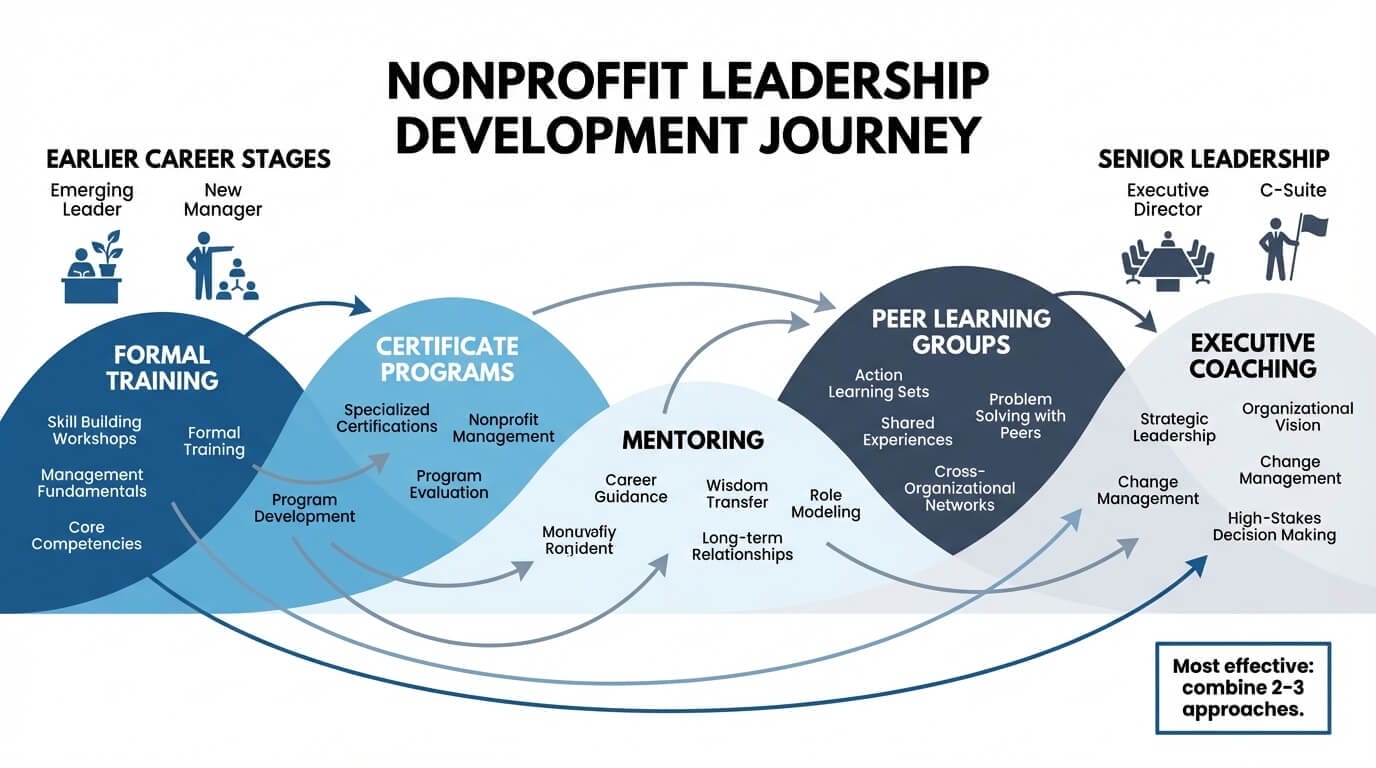
Nonprofit leadership development is not one-size-fits-all, and defaulting to the most familiar approach is not the same as choosing the most effective one. Training builds knowledge. Certificates build credentials. Peer groups build perspective. Mentoring builds wisdom. Coaching builds the capacity to change how you think and act, which is the foundation everything else rests on.
The most effective nonprofit leaders combine approaches. They attend the training that fills a specific knowledge gap. They join the peer group that provides accountability and perspective. And they work with a coach who asks the questions nobody else in their professional life will ask.
If you have not tried coaching, start there. The application takes five minutes. CNPC matches you with an ICF-credentialed coach based on your organizational context, confirms your pricing tier based on your operating budget, and schedules your first session within two weeks. Apply for coaching.
For organizations not ready to apply, or for leaders who want to think further about what development looks like for their role, download our free guide to purpose-driven leadership. It covers the mindset and strategic framework that effective nonprofit leaders build over time, with or without formal development programs.
The sector needs its leaders to stay, grow, and lead well. Development is how that happens. The only question is which combination of approaches fits your situation, your budget, and the specific challenge in front of you right now.
Ready to Close the Gap Between Knowing and Doing?
Training builds knowledge. Coaching changes behavior. CNPC pairs nonprofit leaders with ICF-credentialed volunteer coaches for six sessions starting at $300. The application takes five minutes.
Apply for Coaching →